

Integrated Lighting Solutions in the Renovation and Construction of Modern Stadiums
Stadium lighting is not merely a tool for illuminating the playing field; it is one of the most critical infrastructures affecting the quality of sporting events, the spectator experience, and international standards. This report examines the importance of lighting in modern stadiums, the role of new technologies, technical requirements, and the trend of renovating lighting infrastructure in Iran. In this context, Mojtaba Shafiei (Deputy for Research and Development) and Masoud Mehrshad (Deputy for Operations) at Golnoor, drawing on their technical expertise, production capacity, and operational experience, discuss the challenges, the need for principled design, implementation dimensions, and the impact of standard lighting on the future of stadiums and hosting professional competitions.
Integrated Lighting Solutions in the Renovation and Construction of Modern Stadiums
In Conversation with Engineer Masoud Mehrshad and Engineer Mojtaba Shafiei
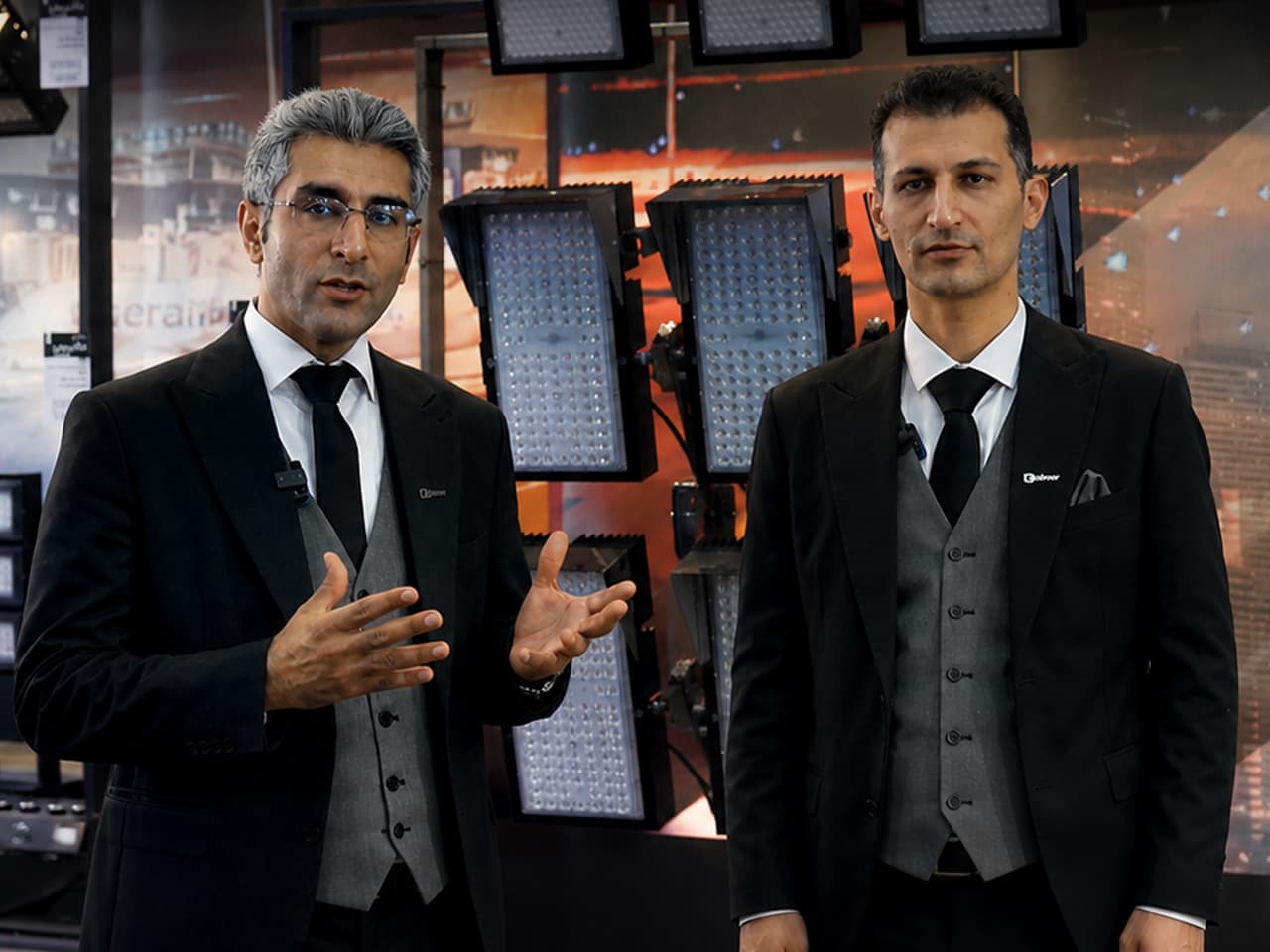
In recent years, the development of sports infrastructure in the country has accelerated. Building and renovating stadiums is no longer limited to creating stands, turf, or architectural structures alone; the quality of technical equipment has become one of the most important criteria for evaluating a professional stadium. Among these, the lighting system holds a special place and can be considered one of the primary factors affecting the quality of a sports complex.
Stadium lighting is not merely a tool for illuminating the playing field; it is one of the most critical infrastructures affecting the quality of sporting events, the spectator experience, and international standards. This report examines the importance of lighting in modern stadiums, the role of new technologies, technical requirements, and the trend of renovating lighting infrastructure in Iran. In this context, Mojtaba Shafiei, Deputy for Research and Development, and Masoud Mehrshad, Deputy for Operations at Golnoor, drawing on their technical knowledge and operational experience, discuss the challenges, the need for principled design, and the impact of standard lighting on the future of stadiums.
Beyond a Tool: Lighting as Stadium Identity
Many people view stadium lighting simply as a means of making the playing field visible; yet in modern engineering, the role of light extends far beyond this basic perspective. According to Masoud Mehrshad, appropriate lighting is part of a stadium's identity and one of the factors that shape the quality of sporting events. When thousands of spectators are present in the stadium and millions follow the match via television, online platforms, and digital media, the quality of light directly affects the audience experience.
Diversity in design requirements is also one of the major challenges in this field. As Masoud Mehrshad explains, depending on the dimensions and type of project, between 10 and 70 luminaires may be installed on each lighting tower in sports stadiums. Since in engineering design the beam angles and placement of each individual luminaire differ from one another, every floodlight must have freedom of movement in different directions — a factor that, in his view, significantly raises the sensitivity and precision required during installation.
Broadcast Requirements and International Standards
Today, international standards for football and other professional sports place special emphasis on lighting. Uniformity of light, appropriate illuminance levels, glare control, accurate color rendering, and providing optimal conditions for professional broadcasting are among the key criteria considered in the design and implementation of stadium lighting systems.
Mojtaba Shafiei emphasizes that appropriate lighting not only improves visibility for players, referees, and operational staff, but also plays an important role in enhancing match safety and elevating broadcast quality. He believes that as imaging technologies advance and match broadcast quality improves, the importance of standard lighting has grown; many matches today are broadcast in HD and 4K, and even the smallest weakness in the lighting system can negatively affect output image quality. For this reason, lighting in modern stadiums worldwide is regarded as one of the core infrastructures of the complex, and detailed technical studies are conducted for its design.
Mojtaba Shafiei goes on to address the lighting requirements of major competitions and states: stadiums hosting international competitions under FIFA or AFC supervision require a minimum of 2,000 lux. Therefore, lighting systems must be designed to precisely meet this level of luminous flux and broadcast image quality.
Smart Control and Flexibility in Lighting Architecture
One of the defining features of lighting in top-tier projects is the compatibility of equipment with different stadium architectures and their control capabilities. Mojtaba Shafiei, referring to the features of the new generation of stadium luminaires (such as the Faraz floodlight), explains: modern stadiums, depending on structural design, require different approaches to light placement; these fixtures can be installed on tall lighting towers or mounted directly on the stadium roof edge (similar to the execution model at Pars Stadium).
He adds regarding the implementation of intelligent lighting scenarios:
«Dimming capability (intelligent increase and decrease of light intensity) and control via the specialized DMX protocol have given designers and project executors greater freedom. With this technology, attractive light-show scenarios and dynamic illuminance management can be implemented during halftime intervals, opening ceremonies, closing events, or various cultural and sporting occasions — significantly enhancing the stadium's visual appeal and atmosphere.»
A Unified Supply Chain in Stadium Lighting: Complete Project Coverage from the Pitch to Office Spaces
According to Mojtaba Shafiei, a modern stadium is a multifaceted structure that, in addition to the playing field, encompasses extensive administrative areas, conference halls, and amenity spaces. Emphasizing a comprehensive solution approach, he believes that supplying both large-scale stadium floodlights and specialized indoor luminaires through a single supply chain ensures technical coordination of the project and minimizes client concerns regarding management, execution, and integration of lighting systems.
As Masoud Mehrshad explains, administrative and interior spaces in stadiums require luminaires with high glare control and modern design that can keep pace with outdoor systems and optimize the overall energy performance of the structure. Using a unified supply chain for the entire project not only creates an integrated, modern lighting identity throughout the stadium, but also improves the project's economic efficiency and greatly simplifies future maintenance.
Grow Light Technology: A New Pillar in Stadium Turf Maintenance
Today, the definition of lighting in world-class stadiums also encompasses biological dimensions and building maintenance. Masoud Mehrshad, highlighting the importance of maintaining playing surface quality, notes:
«One of the major challenges in modern stadiums — especially covered stadiums or those with deep roof overhangs — is the natural turf's lack of access to sufficient sunlight. Today, as one of the key principles in building and maintaining professional stadiums, specialized grow light systems are used during dark periods and when no matches are scheduled to improve, strengthen, and regenerate the structure of natural turf. Golnoor's entry into the design and production of grow lights has effectively completed the technical supply chain for stadiums, enabling clients to maintain the most vital living element of a stadium — the match pitch — under modern lighting standards as well.»
The Renovation Trend and the Entry of New Technologies into Iran's Stadiums
Masoud Mehrshad believes that Iran's stadiums have also embarked on an important path in recent years regarding the renovation of lighting infrastructure. Many stadiums across the country operated with outdated lighting systems in past years — systems that consumed a great deal of energy, incurred significant maintenance costs, and in many cases no longer met new standards.
In this context, the advent of LED technology and the new generation of stadium floodlights has brought a major transformation to this field. According to Mojtaba Shafiei, this technology makes it possible to achieve higher illuminance levels while drastically reducing energy consumption. Longer equipment lifespan, lower maintenance costs, better light quality, and more precise and flexible control are among the advantages that have led most new projects today to adopt this technology. For example, modern systems offer the ability to adjust installation angles for different modules individually or centrally, significantly improving structural static calculations and optical efficiency.
Another traditional challenge in stadiums was the precise adjustment of floodlights after installation on tall lighting towers. Mojtaba Shafiei, referring to an innovative solution in this area, explains: today, to simplify installation, designers mark «aiming points» on the stadium floor. Using systems equipped with internal lasers, technicians can easily target the point on the turf from the top of the tower and perform precise floodlight angle adjustments without error.
Future Outlook: Hosting Professional Competitions
Ultimately, Masoud Mehrshad believes that one of the most important benefits of renovating stadium lighting systems is creating suitable conditions for hosting national and international competitions. A stadium that meets contemporary lighting standards across all its interior, exterior, and even biological (turf) areas can provide better conditions for hosting professional events, high-quality television broadcasts, and spectator attendance. Under such conditions, the lighting system is no longer merely a tool for illuminating the playing field, but becomes a factor in elevating the overall quality of the sporting event and developing national infrastructure.