

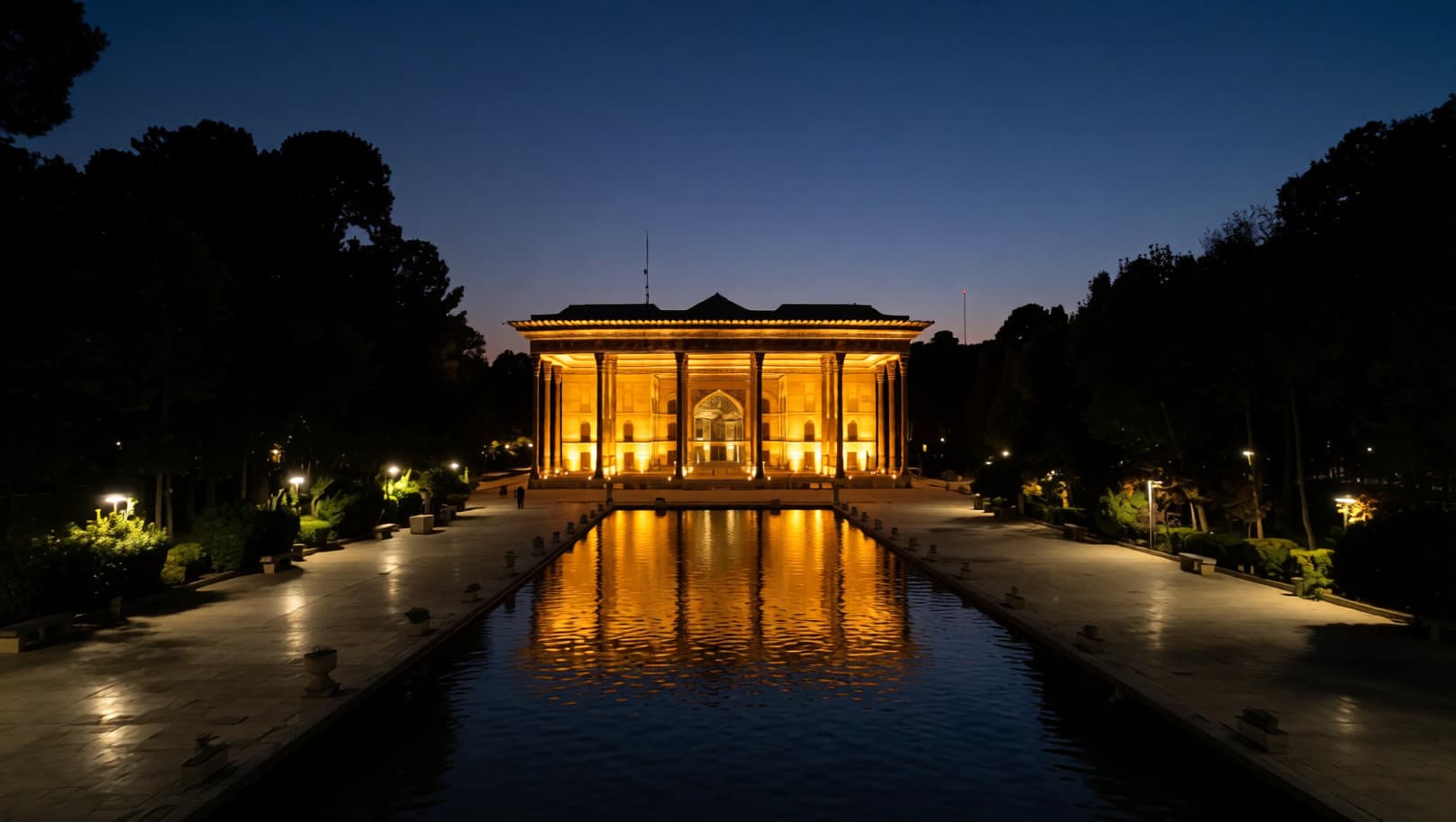
Chehel Sotoun is one of the most significant buildings of the Safavid era in Isfahan: a pavilion set in a garden, known as Chehel Sotoun for its twenty wooden columns and their reflection in the water. That combination is what makes its lighting delicate. Column, portico, water and trees each call for a different behaviour of light.
The aim of the lighting design was not to brighten the space, but to let the building itself be read at night. Light has to reveal the architecture while the equipment stays out of sight, so the luminaires sit low and follow the building's lines, with intensity and direction set section by section.
The garden paths and planting are lit by Tetra park luminaires: even, low-intensity light that makes walking through the garden possible, creates no distracting shadows and keeps attention on the pavilion.
The columns and the lower part of the building are lit by Azarin linear in-ground luminaires. Mounted at ground level, they throw light upward onto the vertical elements. The height of the columns becomes legible and the building separates from the dark ground, while the fixture itself never enters the viewer's frame.
The exterior is covered by Azarakhsh linear floodlights. Their distribution is controlled along the façade, so the surface reads evenly, with no dark or bright patches on the walls and ceiling.
In a historic building, choosing the luminaire is only the beginning. Colour temperature, aiming angle, intensity and mounting distance have to work together, or the result is a few bright spots rather than a lit façade. At Chehel Sotoun that coordination accounted for the materials, the colour of brick and tile, and the garden's place in the city's nightscape.
Lighting historic buildings is part of Golnoor's work, from Naqsh-e Jahan Square and the Baladieh Building in Tehran to Chehel Sotoun. Those projects have shaped a method: before selecting a luminaire, the way light behaves on historic materials is studied, because on a surface that has stood for centuries a mistake in angle or intensity is not easily undone. The design and supply of lighting equipment for Chehel Sotoun followed the same method.
The result is a building that can still be read after sunset, and can take its place on Isfahan's night-time tourist route.