

Tunnel lighting: design and smart control | Golnoor
Tunnel lighting principles, entrance and transition zones, LED luminaire requirements, the Ariel floodlight and the Andromeda Theta control system for safety and energy.
Tunnel lighting: design principles, LED luminaire selection and smart control systems
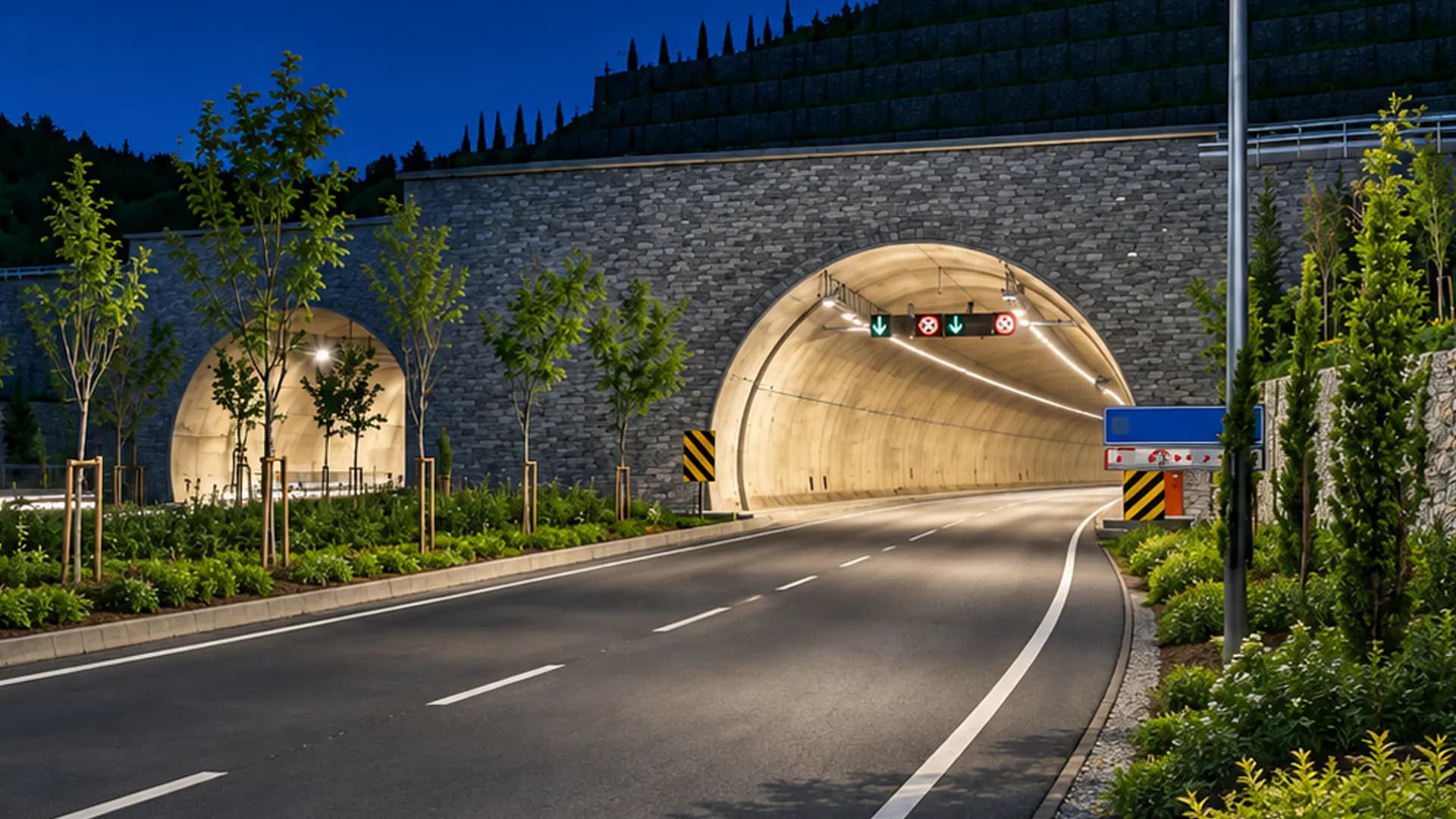
Tunnel lighting is not only about providing light along an enclosed route; it is part of road safety design that must help drivers pass through changes in ambient brightness correctly, recognise obstacles and travel with continuous visibility.
Why tunnel lighting matters
Approaching a tunnel, a driver moves from an outdoor environment with very different light conditions into an enclosed space. If the portal and interior lighting are not designed properly, that change can make it difficult to read the road, other vehicles, signs and obstacles. One of the most important issues is the black hole effect: the tunnel entrance appears very dark compared with the bright exterior.
The aim of tunnel lighting design is to reduce this visual contrast and to give drivers the conditions they need to adapt gradually. Controlled light distribution, uniform luminance and glare management together support safety and the smooth flow of traffic.
The main lighting zones of a tunnel
Lighting requirements are not the same along the whole tunnel. The Golnoor tunnel lighting brochure introduces four main zones for lighting planning.
1. Entrance / threshold zone
In the first section of the tunnel, the difference between outdoor and interior brightness matters more than anywhere else. Lighting in this zone should help reduce the black hole effect and make the road and obstacles visible at the moment of entry. Adjusting light levels to match outdoor conditions is a key design principle here.
2. Transition zone
After the threshold, light levels should fall gradually so the driver's eye has time to adapt. A sudden drop in light, poor uniformity or disturbing shadows can break the continuity of vision. This zone is therefore designed around stepwise reduction of light and visual comfort.
3. Interior zone
In the interior of the tunnel, the main goal is stable, uniform lighting along the route. Controlling glare and shadows and allowing lane markings, vehicles and possible obstacles to be seen are the functional requirements of this zone.
4. Exit zone
Near the exit, the driver again faces outdoor brightness. Lighting design here should take that change in visibility into account and help the eye readjust.
Required luminance and the length of each zone must be set according to the real conditions of the project and specialist lighting calculations; a fixed pattern is not enough for every tunnel.
What should a tunnel LED luminaire offer?
Tunnel luminaires work in environments with particular operating conditions. Humidity, dust, pollution and long operating hours make the choice of the right equipment an important decision over the life of the project.
Engineered light distribution: directing light to the surfaces that need it and helping visibility stay uniform along the route.
Glare control: reducing stray light in the driver's field of view.
Environmental resistance: a design suited to humidity, dust and pollution in tunnel environments.
Good luminous efficacy: reaching the required lighting performance while managing electricity use.
Luminous flux stability: maintaining performance over time and reducing the need for maintenance.
Controllability: the ability to dim output when compatible control equipment and infrastructure are used.
The Golnoor Ariel floodlight as a tunnel lighting solution
Within its tunnel lighting solutions, Golnoor presents the Ariel floodlight. You can find it in the site's floodlighting section, alongside Golnoor's other outdoor floodlights. Using LED technology, industrial design and a range of optical options, it is offered to meet the lighting needs of tunnel projects and their entrance and exit areas.
According to the product brochure, resistance to environmental factors, high luminous efficacy, luminous flux stability and compatibility with lighting management systems are key features in the Ariel design. The arrangement of the luminaires, the type of optic and the output setting should be chosen according to the tunnel geometry and the results of lighting calculations.
Energy efficiency and maintenance cost in tunnel lighting
Long-term operation turns energy consumption and maintenance costs into two important factors in decision-making. High-efficacy LEDs and suitable optics can help deliver the required luminance with managed energy use.
In the economic assessment of a project, the initial power consumption of the luminaire is not the only factor; luminous flux stability, access for repairs, the maintenance plan and the ability to dim output must also be considered. These points apply both to new tunnels and to the renovation of existing lighting systems.
How does smart tunnel lighting control work?
The lighting needs of a tunnel portal are not constant through the day or as weather changes. At sunset, for example, or when pollution reduces ambient brightness, the output of dimmable luminaires can be adjusted to the new conditions.
The Andromeda Theta system is presented in the Golnoor brochure as a solution for smart control of lighting in the threshold and transition zones. It receives luminance sensor data from the tunnel portal, processes it in a central control unit and sends dimming commands to the control gear of the luminaires.
Main components of the Andromeda Theta system
A luminance measurement sensor at the tunnel portal.
A central control unit based on a PLC and an industrial microcontroller.
Sensor-to-controller communication in analogue form, including a 4–20 mA current signal, or digitally over RS485 with the Modbus RTU protocol.
Sending control commands to the luminaire control gear over wireless communication or a data cable, depending on the project configuration.
This structure allows groups or individual luminaires in different zones to be controlled, day and night scenarios to be defined and light intensity to be adjusted with environmental change. The brochure also notes that the system is ready to connect to tunnel monitoring and central management systems.
What to review when choosing a tunnel lighting solution
When selecting tunnel lighting equipment, it is better to assess the design and the product as one package. Tunnel geometry and length, portal light conditions, vehicle speed, visibility requirements, luminaire layout, glare control and operating scenarios all affect the final result.
Once project needs are defined, the optical and control options of the luminaires can be reviewed and a solution chosen that matches the expected performance level and life-cycle cost.
Conclusion
Effective tunnel lighting comes from the alignment of zone design, the right luminaire and smart control. From reducing the black hole effect at the entrance to keeping light uniform in the interior, every part of the route needs its own engineering attention.
By presenting the Ariel LED floodlight and the Andromeda Theta control system, Golnoor offers a set of product and control solutions for tunnel lighting projects, which can be reviewed both for new designs and for upgrading the lighting of existing tunnels.
Source: Golnoor's "Tunnel Lighting" brochure; the tunnel lighting principles, Ariel floodlight and Andromeda Theta system sections.