

Best Street Light Brand: 12 Criteria to Choose Right
How to choose the best street light brand: 12 criteria incl. real manufacturing, IES/LDT files, lm/W, IP & IK, optics, written warranty and service. With checklist.
Best Street Light Brand: 12 Criteria for Choosing an LED Street Light
An LED street light buying guide for municipalities, contractors and lighting consultants
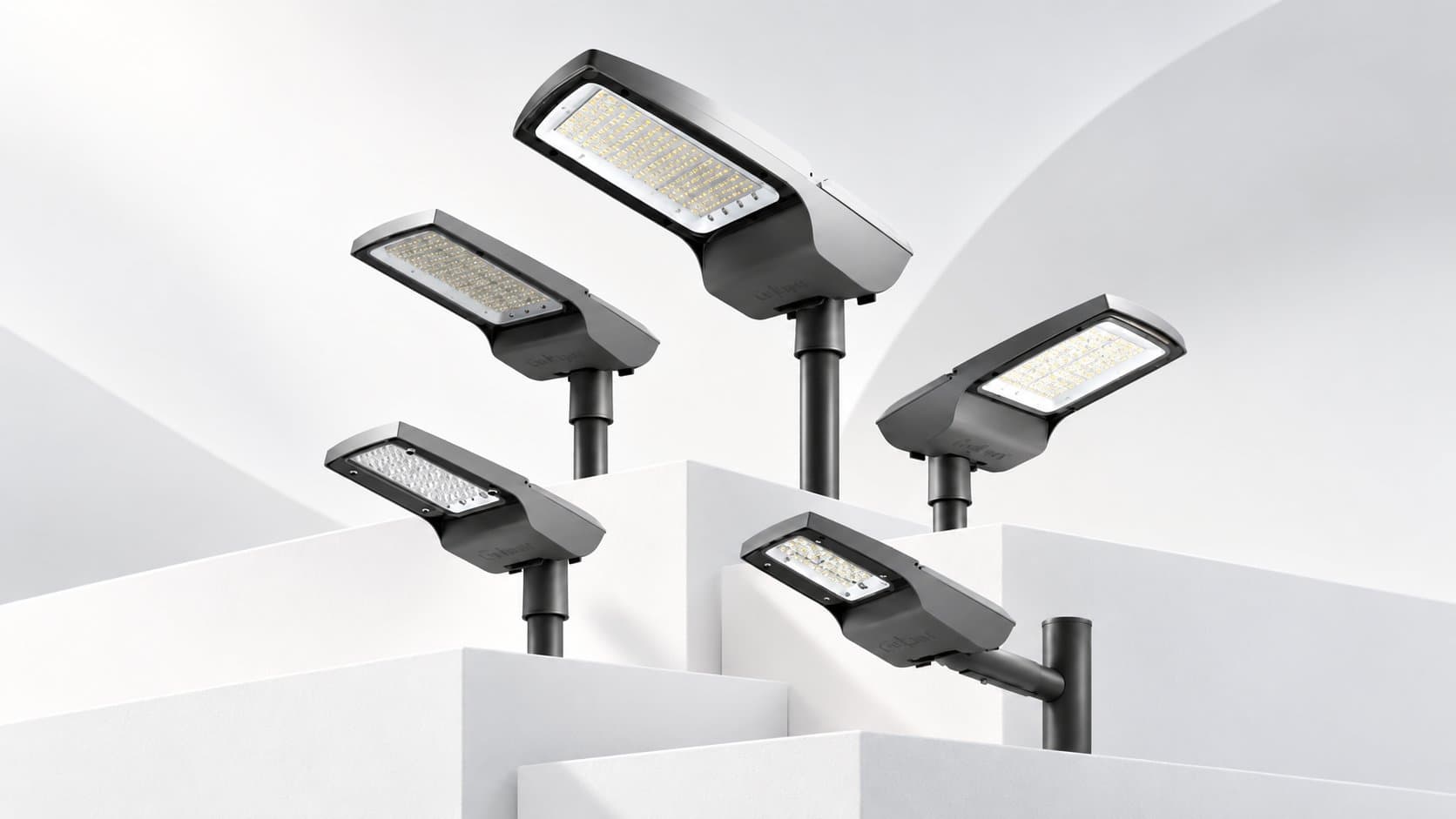
Short answer: the best street light brand is one that actually manufactures its products, publishes an IES/LDT photometric file and a complete datasheet for every model, states luminous flux and efficacy (lumens per watt) clearly, declares IP and IK ratings, gives a written warranty, provides real after-sales support, and can point you to completed projects you can visit.
No ranked list can tell you the best street light brand for your project: a brand that suits a busy highway is not necessarily the best choice for the lanes of a residential estate. What stays the same across projects are the evaluation criteria. This guide is written for municipal engineers, contractors, lighting consultants and buyers of road and industrial projects, and shows what evidence to ask each brand for before you sign an order, and which answers to accept.
If you are looking for Golnoor's street light models and specifications, see the Golnoor LED street lighting page.
Why "the best street light brand" is a checklist, not a name
A street light works for years through heat, cold, rain, dust and voltage fluctuations, and replacing one on a pole means a lift truck, technicians and sometimes a lane closure. Buying well means reducing risk over the luminaire's whole life, not just on delivery day. Trust a brand that can back its claims with documents. Below are twelve criteria, in the order they come up in a technical and commercial evaluation of an offer.
1. Real manufacturer or importer and re-labeller?
The first question is whether you are dealing with the maker or with a seller who offers someone else's product under its own name. A manufacturer controls housing design, component selection, assembly and quality control, and when something goes wrong it can trace the root cause. A re-labeller can usually only swap the part.
How to tell whether a brand really manufactures
- Ask for the factory address and whether you can visit the production line.
- Check whether models follow an orderly naming and generation scheme and have been updated over time.
- Ask a technical specialist about design details (heat sink, lens, driver); a salesperson's answer and a designer's answer are quickly told apart.
2. Real photometric data and catalogue transparency: IES/LDT files and DIALux
The most important technical document of a street light is its photometric file. IES and LDT files describe the luminaire's light distribution, and by importing them into software such as DIALux a designer can check, before buying, whether the luminaire reaches the required lighting level and uniformity on the real road, with the real pole height and spacing.
A brand that does not publish photometric files is effectively asking you to buy without calculation. Besides the photometric file, each model's datasheet should include at least: power, luminous flux, efficacy, colour temperature and colour rendering index, IP and IK ratings, power factor, operating temperature range, spigot diameter and warranty period. Ask the seller about anything missing.
3. Luminous flux and efficacy: the mark of a good LED street light
Watts only show power consumption, not the amount of light. Two luminaires of the same wattage can deliver very different luminous flux. The right basis for comparison is luminous flux (lumens) and luminous efficacy (lumens per watt). A good LED street light delivers more light per watt and shows consistent figures in its datasheet and photometric file.
Keep two points in mind:
- Ask whether the stated lumens are the luminaire's total output or the LED chips' flux before lens and thermal losses. What reaches the street is the luminaire output.
- If the stated figure does not match the IES file of the same model, trust the photometric document and ask for an explanation.
To learn more, read why wattage alone is not a basis for comparison.
What wattage street light should you buy? 50, 100, 150 and 200 W
The exact answer only comes from a lighting calculation: road width and number of lanes, pole arrangement, mounting height, arm length, lighting class and the luminaire's distribution curve determine the power needed. There is no fixed number for a "street" or a "highway". Still, knowing the options available at each wattage helps you compare offers. For example, in Golnoor's range:
| Power | Model | Stated luminous flux |
|---|---|---|
| 50 W | Soheil i-1 | 5,000 lm |
| 100 W | Setareh S gen2 | 15,500–16,100 lm |
| 100 W | Soheil i-2 | 9,500 lm |
| 150 W | Soheil i-2 | 14,250 lm |
| 155 W | Setareh M gen2 | 26,000–27,000 lm |
| 200 W | Setareh M gen2 | 33,200–34,400 lm |
| 200 W | Soheil i-3 | 19,000 lm |
This table shows why comparing by watts is misleading: at 200 W, two models from the same manufacturer differ widely in luminous flux. Lower and higher wattages exist too, from Setareh XS gen2 at 10–45 W and Sarina at 20–35 W (2,600–4,200 lm) up to Setareh L gen2 (210 and 250 W) and Setareh XL gen2 (320 and 380 W). The right method is to compare several options with their photometric files in DIALux and choose the combination that meets the lighting class with the fewest poles.
4. Driver quality and surge protection
The driver is the electronic heart of an LED luminaire, and in many field failures it, not the LED, is the weak point. Ask the brand to state in writing the driver's maker and specifications, power factor, input voltage range and type of surge protection. On networks where voltage fluctuations or lightning are common, specify the surge protection level and the option of an additional protector in the contract. Also ask whether the driver can be replaced on its own, or whether a driver failure means replacing the whole luminaire.
5. Thermal design, heat sink and housing material
Heat is the enemy of LED and driver life. A street light housing must draw heat away from the chips efficiently, which is why heat sink material and design matter so much. A die-cast aluminium housing with suitable cooling fins is the most common solution in quality street lights. Check the operating temperature range in the datasheet and compare it with the project's climate. The housing paint and fasteners should also be checked for corrosion resistance, especially in coastal areas.
6. IP protection rating and IK impact resistance
- IP: shows how well the luminaire is protected against dust and water. For a street light, IP66 means full dust protection and protection against powerful water jets.
- IK: shows the resistance of the housing or glass to mechanical impact; a higher number means more resistance. On roads where stone-throwing or vandalism is likely, IK matters more.
Ask which part the stated IK refers to (housing or glass) and whether it is the same for all wattages in a family.
7. Optics, road lighting class and glare control
A good street light sends light where it is needed: onto the carriageway and sidewalk, not into the sky or drivers' eyes. Street lenses with different distribution curves are designed for different road widths.
EN 13201 and lighting classes
In many projects the lighting class is set by the European standard EN 13201 or by the client's and road operator's requirements. In this standard, M classes are for motorised traffic routes and based on road surface luminance, C classes for conflict areas such as roundabouts and intersections, and P classes for pedestrian paths and low-speed roads. A good brand must be able to show with its photometric file that its luminaire meets the selected class in your design.
Full cut-off and light pollution
Full cut-off optics mean the luminaire emits no light above the horizon. This reduces glare, prevents light being wasted into the sky and helps reduce light pollution.
8. Colour temperature and colour rendering index
The client or designer chooses colour temperature based on road type and project requirements. Warmer light (around 3000 K) is usually used in residential areas and historic districts, and neutral light (around 4000 K) on many streets and highways. Prefer a brand that offers several colour temperatures for the same model, so you don't have to change model or brand to change CCT. Ask for the colour rendering index (CRI) in the datasheet as well.
9. Written warranty and declared lifetime
A verbal warranty is worthless. The warranty text must clearly state its period, scope (which defects are covered and what is excluded), installation conditions and who determines a fault. Ask for lifetime with a standard metric such as L70B10: the time until which at least 90% of luminaires retain at least 70% of their initial flux. A lifetime figure without this definition cannot be compared.
10. After-sales service and spare parts
The key question is: if a luminaire fails in your city three years from now, who responds, and how fast? Check service centres, a dedicated contact number, the request procedure and spare-part supply (driver, lens, sealing gasket) for the models sold. For city projects maintained over many years, continuity of a product family or compatibility of a new generation with the previous one also matters.
11. Test documentation and projects you can visit
A claim of compliance with a standard must come with a test report or valid certificate. Ask the brand for photometric and safety test reports for each model and check the laboratory name and test date. More important than any catalogue are completed projects: ask for the name, location and year of projects similar to yours and, if possible, visit them at night. A luminaire that has worked on a highway for several years says more than any brochure.
12. Compatibility with poles and arms
In retrofit projects, the LED luminaire is usually mounted on the existing arm. The luminaire's spigot diameter must match the arm; check this figure in the datasheet. If you buy poles and luminaires together, sourcing both from one supplier makes it easier to coordinate height, arm length and tilt angle with the DIALux design.
Street light price vs. total cost of ownership
Street light price depends on wattage and luminous flux, lens type, driver, housing, protection rating, colour temperature and warranty period. But the cheapest offer is not necessarily the cheapest choice. The real cost of a luminaire over its life is made up of several parts:
- Purchase price of the luminaire and, if needed, the pole and arm;
- Energy cost: a luminaire with higher efficacy needs less power to reach the same lighting level and sometimes fewer poles;
- Maintenance cost: every failure means a lift truck, technicians and sometimes a lane closure;
- Downtime risk: a dark road has a cost in safety and public satisfaction.
For a fair comparison, evaluate offers against the same lighting design (same road, same class, same pole spacing), not the price per luminaire.
Checklist for choosing the best street light brand
| Criterion | Evidence to ask for | Convincing answer |
|---|---|---|
| Real manufacturer | Factory address, visit option | Defined production line and technical team |
| Photometric data | IES/LDT file for each model | Downloadable file consistent with the datasheet |
| Flux and efficacy | Datasheet and photometric file | Explicit luminaire output lumens and lm/W |
| Driver and surge | Driver specs and surge protection | Maker, power factor and protection level in writing |
| Thermal design | Housing material, operating temperature range | Aluminium housing with a suitable heat sink |
| IP and IK | Datasheet | IP66 and a stated IK for each model |
| Optics and glare | Distribution curve, DIALux design | Meets EN 13201 class or project requirements; full cut-off |
| CCT and CRI | CCT options | Several colour temperatures for one model |
| Warranty and lifetime | Written warranty, L70B10 | Clear period, scope and conditions |
| After-sales service | List of service centres, request procedure | Regional coverage and a dedicated contact number |
| Tests and projects | Test reports, project list | Visitable projects with name, location and year |
| Pole compatibility | Spigot diameter | Matches the existing arm, or poles supplied |
| Total cost | Offers based on the same design | Energy, maintenance and price compared together |
How Golnoor meets these criteria
Golnoor is an Iranian manufacturer of urban, industrial and architectural lighting, and its street lights are made at the Golnoor factory in Isfahan. Here is how Golnoor street lights measure up against the criteria above:
- Power range: the Setareh gen2 (XS to XL), Sarina and Soheil (i-1 to i-4) families, from 10 to 380 W.
- Efficacy: depending on the model, the Setareh gen2 family offers 152–190 lm/W efficacy and 1,830–68,000 lm luminous flux. Each model's flux is listed on its product page.
- Photometric data and DIALux: Golnoor is an official DIALux member (Silver level) and provides IES and LDT files for its street lights. Golnoor's online and offline plugin is available on the Golnoor DIALux page.
- Housing and protection: all active models have a die-cast aluminium housing, tempered glass, IP66, a 0.95 power factor and insulation class I. Housing IK for the Setareh gen2 family is stated as IK09. Each model's operating temperature range is given in its datasheet.
- Optics: all Golnoor street lights have full cut-off optics.
- Colour temperature: Golnoor street lights are offered from 3000 to 6500 K; CRI of active models is 75.
- Warranty and lifetime: Setareh gen2 carries a 7-year warranty, Sarina 5 years and Soheil 3 years. L70B10 lifetime is stated as 100,000 hours for Setareh and Sarina and 70,000 hours for Soheil. Written warranty terms are published on the Golnoor after-sales service page.
- After-sales service: the same page lists Golnoor's after-sales service centres in several cities across Iran, along with how to submit a request.
- Poles and arms: spigot diameter ranges from 33 to 60 mm depending on the model. Golnoor supplies conical and polygonal lighting poles, arm brackets and other poles through its steel structures division.
- Projects you can visit: including Isfahan–Shiraz freeway lighting, Kish Island street lighting, the Basra–Zubair highway and Feiz Boulevard, Isfahan; in the first three projects the poles were supplied along with the luminaires. The full list is in street and road lighting projects.
- Solar street lights: Golnoor also offers solar street lights; contact the sales team for models and specifications.
For prices, see the latest Golnoor price list, or for a project quote send the road width, pole height and quantity to the Golnoor sales team or contact our sales representatives. On upgrading a lighting network, read street lighting optimization with the HE series.
Choosing the right luminaire for your project: see all models, technical specifications and photometric files on the Golnoor LED street lights page.
Frequently asked questions
6 questions